How to play Backgammon Super
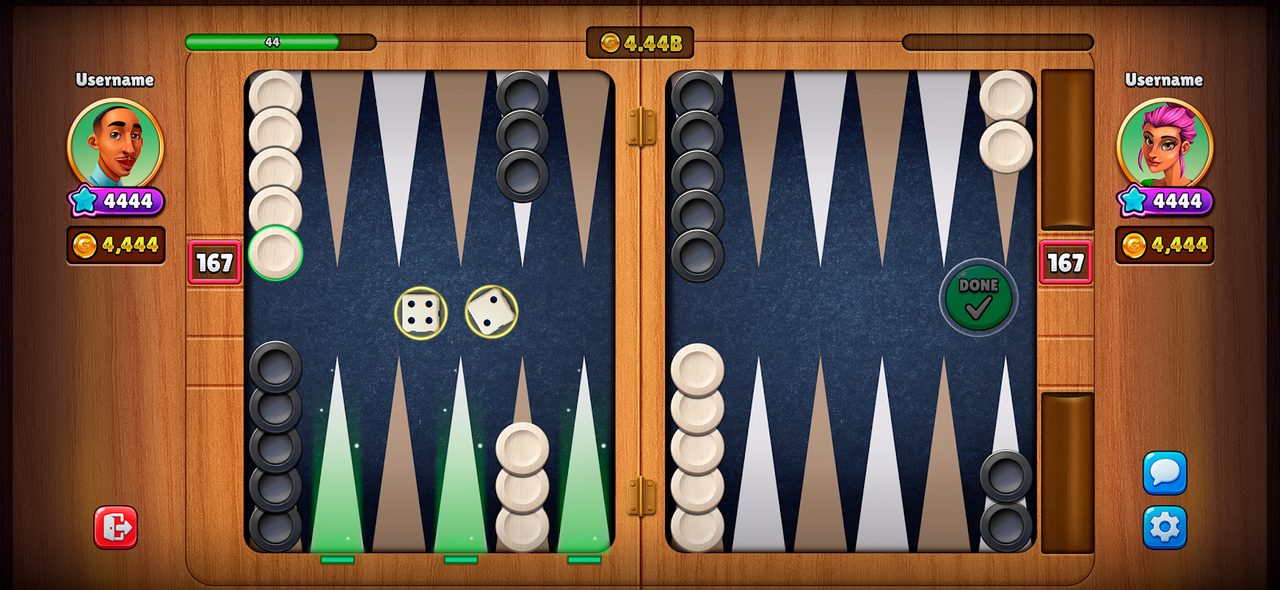
Backgammon is a two-player race around the board. Roll the dice, move all 15 of your checkers into your home board and bear them off before your opponent does.
Step by step
-
1
The setup
Each player has 15 checkers on a board of 24 points. You move your checkers around the board toward your home board, while your opponent moves the other way.
-
2
Roll and move
Roll two dice and move one checker by each number, or one checker by both. Roll a double and you move that number four times. You must use both dice if you can.
-
3
Where you can land
You can move to any point that is empty, holds your own checkers or holds a single opposing checker. A point with two or more opposing checkers is blocked.
-
4
Hit and the bar
Land on a single opposing checker (a blot) to hit it and send it to the bar. A checker on the bar must re-enter in the opponent's home board before any other move.
-
5
Bear off
Once all 15 of your checkers are in your home board you may start bearing them off, using the dice to take them off the board.
-
6
Win the game
The first player to bear off all 15 checkers wins. Win big and the game counts double or triple.
Scoring
- Single game
- You bear off all your checkers after your opponent has borne off at least one: the stake counts once.
- Gammon
- Your opponent has not borne off a single checker: the stake counts double.
- Backgammon
- Your opponent has not borne off any checker and still has one on the bar or in your home board: the stake counts triple.
- Doubling cube
- Before your roll you may offer to double the stake. Your opponent accepts and plays on, or declines and loses the game at the current stake.
Tips for new players
- Make your 5-point early - it is the most valuable point on the board.
- Avoid leaving single checkers (blots) where your opponent can hit them with a likely roll.
- Build a prime - several blocked points in a row - to trap your opponent's checkers.
- Count pips: if you are ahead in the race, run for home; if you are behind, hold an anchor and wait for a shot.
- Use the doubling cube when you are clearly ahead - and know when to decline.
Did you know?
- Board games of the backgammon family are about 5,000 years old - one of the oldest known sets was found in the Burnt City in Iran.
- The doubling cube was added to backgammon in the 1920s and turned it into a game of risk and nerve.
- A standard backgammon board has 24 points and 30 checkers - 15 for each player.
- Backgammon is known as tavla in Turkey, shesh besh in the Middle East and nardy in Russia.


